

Hair, Tips & Advice
INOA vs Majirel: Which L’Oréal Professional Hair Colour Is Better?
Aug
INOA vs Majirel: Which L’Oréal Professional Hair Colour Is Better?
INOA and Majirel are both permanent L’Oréal Professionnel colour ranges, both can cover up to 100% white hair, and both develop for 35 minutes. Yet they do not feel, mix or perform in exactly the same way.
The choice is not simply “ammonia-free versus ammonia”. INOA uses a different colour-delivery system, requires its own developer and produces a noticeably different salon experience. Majirel remains the more traditional cream-colour system, although its current formula has been updated to reduce ammonia odour and improve softness.
So which one is better? That depends on whether the priority is scalp comfort, shine, shade flexibility, lift or dense white-hair coverage.
What Is the Main Difference Between INOA and Majirel?
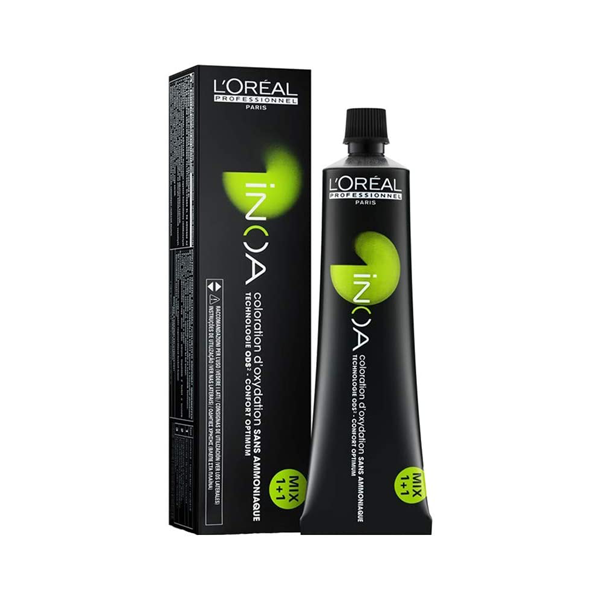
INOA is an ammonia-free permanent colour powered by L’Oréal’s Oil Delivery System. Its formula contains 60% oil, which helps carry the colourants into the hair while using a small amount of another alkaline agent, MEA, to open the cuticle.
This is an important distinction. Ammonia-free does not mean chemical-free, non-oxidative or allergy-free. INOA is still a permanent oxidative colour and still requires its dedicated developer, professional application and the required allergy alert test.
The practical advantage is the service experience. INOA has no ammonia smell, a fluid texture and is designed to provide high-impact colour with increased shine and optimal scalp comfort. L’Oréal reports up to 48% shinier results compared with the hair before colouring.
Majirel uses an ammonia-based cream formula. The latest version pairs with L’Oréal’s Odour Trapping Technology Oxydant, which is designed to keep more of the ammonia within the colour mixture rather than allowing it to evaporate into the salon. L’Oréal claims up to twice less ammonia odour than the previous formula, along with richer application and up to three times softer hair.
Majirel has therefore become more pleasant to work with, but it is not ammonia-free.
INOA and Majirel Have Different Mixing Ratios
INOA is mixed in equal parts: 60g of INOA colour with 60g of INOA Oil Developer. Only the dedicated INOA developer should be used. It is available in 10, 20 and 30 volume strengths, and the mixture develops for 35 minutes.
Majirel uses a 1:1.5 ratio. One current 60ml tube is mixed with 90ml of Majirel OTT Cream Oxydant. Standard Majirel can be used with 12.5, 20 or 30 volume developer and also develops for 35 minutes.
The developers are not interchangeable. INOA’s oil-based system depends on INOA Oil Developer, while Majirel’s updated performance and reduced-odour claims depend on its matching OTT Oxydant.
Which One Is Better for Grey or White Hair?
Both ranges offer up to 100% white-hair coverage, so INOA is not a weaker colour simply because it contains no ammonia. The more important issue is the shade formula.
Majirel has clear coverage rules. When the hair contains up to 50% white, the target shade can generally be used alone with 20 volume developer. For 50% to 100% white hair, reflective shades are usually mixed with a matching natural or golden base to give the formula enough background pigment for solid coverage.
INOA can also provide full white-hair coverage, but it has its own formulation rules and shade families. A colourist should not transfer a Majirel formula directly into INOA simply because the shade numbers appear similar.
For resistant white regrowth, correct saturation and the full 35-minute development time matter more than choosing the colour with the strongest smell. Neither range will cover properly when applied too sparingly or rinsed early.
Which Gives More Shine?
INOA has the stronger positioning for shine. The oil-rich formula is designed to leave the hair with a polished, reflective finish, making it particularly attractive for brunettes, rich natural shades and clients who want permanent colour without the traditional ammonia experience.
Majirel tends to produce the denser, creamier colour result associated with classic permanent tint. It is especially effective when the aim is an even, rich result from roots to ends, with strong true-to-tone reflect and reliable white-hair coverage.
That does not mean INOA looks transparent or Majirel looks dull. The starting base, selected reflect, porosity and condition of the hair will influence the final result far more than the name on the tube.
Is INOA Better for Damaged Hair?
INOA is often assumed to be the automatic choice for damaged hair because it is ammonia-free. That is too simple.
Both INOA and Majirel are permanent oxidative colours. Neither should be repeatedly applied through fragile, lightened or highly porous lengths without a clear reason. INOA’s oil system may provide a more comfortable, glossy service, while the current Majirel formula contains a caring complex intended to improve softness. Neither product repairs severe structural damage.
Where the roots need permanent colour but the lengths only need their tone refreshed, a professional may use permanent colour on the regrowth and a suitable demi-permanent colour on the lengths. This avoids repeatedly exposing the oldest part of the hair to a permanent-colour formula.
Which One Lifts Hair Better?
Standard INOA and standard Majirel can both provide up to approximately three levels of lift when used with their respective 30 volume developers. INOA 20 volume and Majirel 20 volume provide up to two levels of lift.
Neither range will reliably lift through previously applied permanent dark colour. A stronger developer does not make permanent colour remove old artificial pigment evenly.
Majirel does have separate specialist families, including Majirel High Lift, for services beyond the capability of the standard range. These products have different ratios and processing rules and should not be treated as ordinary Majirel shades.
INOA or Majirel
Choose INOA when the client specifically wants permanent ammonia-free colour, dislikes the smell of conventional tint or prioritises shine and scalp comfort. It is particularly well suited to clients who enjoy a polished, luxurious colour service but still need lasting colour or white-hair coverage.
Choose Majirel when the priority is a rich, traditional permanent-colour result, broad shade flexibility and a familiar cream consistency. Its extensive reflect families and predictable coverage rules make it a dependable salon colour system.
Neither is universally better. INOA offers the more distinctive ammonia-free experience; Majirel offers the classic permanent-colour performance many colourists already know how to control. The best result comes from matching the range to the hair—not choosing one because its marketing sounds gentler or stronger.
