

Uncategorized
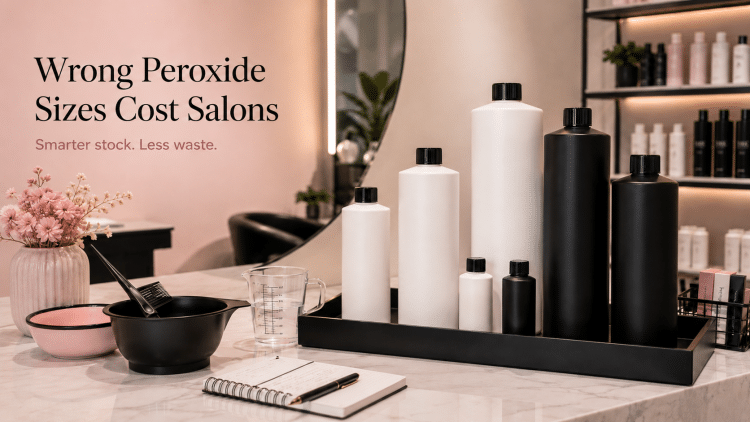
Why Some Salons Waste Money on the Wrong Peroxide Developer Sizes
Jun
Most salon owners know when colour is expensive. They know when bleach prices go up. They notice when a box of foils disappears faster than expected. But peroxide developer? That often slips under the radar.
It sits on the colour bar, gets opened, half-used, replaced, borrowed between stylists, reordered “just in case”, and sometimes forgotten at the back of a shelf. On its own, one bottle might not look like a major cost. Across a busy salon, over months of colouring, toning, blonding, grey coverage and corrections, poor developer buying can quietly become a real waste problem.
And the issue is not always that the salon is using too much developer. Often, the salon is buying the wrong sizes, the wrong strengths, or too many systems at the same time. If your colour bar always has half-empty bottles, emergency top-up orders, or peroxide strengths that no one seems to use, this is worth looking at.
At The Hair & Beauty Company, we supply professional salon products for hair, beauty, barbering and nails across Ireland. This guide is written for salon owners, colour managers and professional stylists who want a smarter, less wasteful way to manage their colour stock.
Developer Waste Usually Starts Before the Colour Is Mixed
When people talk about colour waste, they usually talk about over-mixing colour. That is part of the problem, of course. But waste often starts earlier, when the salon orders peroxide without looking at how it is actually used.
A salon may have:
- Too many large bottles open at the same time
- A 40 vol developer that barely moves
- Several brands of developer sitting beside different colour lines
- Small amounts left in multiple bottles
- Staff opening a fresh bottle instead of finishing the old one
- A busy week where the salon runs out of the developer it uses most
- Slow-moving peroxide that was bought because “we might need it”
That is not just a product issue. It is a stock control issue. The mistake many salons make is treating peroxide like a basic background product. In reality, developer is part of your colour system, your service timing, your stock rotation and your profit margin.
If your salon is regularly buying professional colour, bleach, toners and developers, your peroxide stock deserves the same attention as your colour tubes. You can browse THBC’s professional Peroxide & Developers range to see the different brands and formats available for trade customers.
The Cheapest Bottle Is Not Always the Cheapest Choice
It is easy to look at a larger bottle and think, “That is better value.” Sometimes it is.
If your salon uses a certain developer strength every day, a larger size can make complete sense. Busy colour salons, blonding specialists and salons with several stylists working from the same colour system may get through larger bottles quickly. But bigger is only better when the product moves.
A large bottle becomes a waste problem when it is opened, used once or twice, and then sits there while the salon moves on to other services or another colour brand. The cost per ml might have looked better on the order, but if part of the bottle ends up unused, the saving is gone. This is where salon owners need to think beyond the shelf price.
A better question is:
How quickly will this exact developer strength be used in this salon?
Not in an ideal week. Not during the Christmas rush. Not during a big colour correction month.
In normal salon life. If a developer is used every day, a larger size may be the right choice. If it is used occasionally, a smaller size may protect your cash flow and reduce waste.
For example, THBC stocks options such as Wella Welloxon Perfect Developer 1 Litre as well as smaller formats like Wella Welloxon Perfect Developer 60ml. The right choice depends on how your salon actually works, not just which size looks cheaper at first glance.
Some Salons Overstock the Developers They Barely Use
Every colour bar has a pattern. There are developers that are constantly used. Then there are the ones that sit there for specific cases, occasional services, training sessions or corrections. The problem starts when a salon buys every developer strength in the same quantity.
A salon might reorder 10 vol, 20 vol, 30 vol and 40 vol as if they all move at the same speed. But most salons do not use every strength equally. One strength may be needed constantly for grey coverage or toning. Another may only be used for certain blonding services or specific colour results.
That does not mean the less-used developers are unnecessary. It means they should be ordered differently. Salon owners should look at developer stock in two groups:
Fast-moving developer:
The strengths and brands your team uses every week.
Occasional-use developer:
The strengths or systems needed for specific services, but not used daily.
Fast-moving developer can often justify larger formats. Occasional-use developer usually needs tighter buying.
This is one of the easiest ways to reduce colour bar waste without changing the quality of your colour work.
Wrong-Size Buying Creates Emergency Orders Too
Waste is not only what gets thrown away. Sometimes the bigger cost is what happens when the salon runs out of the developer it actually needs.
If you have five bottles of a slow-moving strength but no bottle left of the one your team uses every day, that creates problems:
- Staff lose time looking for stock
- Services may be delayed
- Someone has to place an urgent order
- The salon may buy whatever is available instead of what it normally uses
- Colour work becomes more stressful than it needs to be
This is why developer planning should not be based on “Do we have peroxide?”
It should be based on:
- Which developer strengths are used most?
- Which colour systems need a matching developer?
- Which sizes are being opened and finished?
- Which products are sitting for too long?
- Which developer runs out first every month?
A salon does not need a complicated stock system to answer this. Even a simple 4-week colour bar check can show which peroxide sizes are helping and which are tying up money.
Mixing Too Many Developer Brands Can Also Waste Money
Many salons carry more than one professional colour brand. That can be normal, especially if different stylists prefer different systems or the salon offers a wide range of services. But when developer brands start to pile up, the colour bar can become messy.
You may end up with one developer for one colour line, another for a demi range, another for bleach, and a few extras bought for a product trial that never became part of the main service menu. The result? Open bottles everywhere.
This can create staff confusion, poor stock rotation and unnecessary repurchasing.
A better approach is to organise your colour bar by system. Keep the developers beside the colour or bleach products they belong with. Make it obvious what is used daily and what is only for specific services.
THBC carries a wide range of professional Hair Colour and Bleach & Peroxide products, including trade-only professional colour categories. If your salon uses multiple brands, keeping each system tidy is one of the simplest ways to reduce unnecessary waste.
Demi Developers Need Their Own Stock Plan
Another common mistake is treating every developer like it belongs in the same general peroxide stock. Demi developers often need separate planning because they are linked to specific demi-permanent colour services. If your salon offers glossing, toning, blending or lower-commitment colour services, these developers may be important. But if those services are only occasional, overbuying can quickly lead to slow-moving stock.
This is especially relevant for salons expanding their colour menu. A salon may get excited about introducing more demi work, order too much stock, and then realise the team has not yet built enough demand for those services.
The smarter approach is to match your ordering to actual bookings.
Ask:
- How many demi services did we do last month?
- Are we promoting glossing and toning properly?
- Are stylists recommending demi colour where suitable?
- Do we need more training before increasing stock?
- Are we buying for real demand or hoped-for demand?
If demi colour is growing in your salon, plan for it properly. If it is still occasional, keep the stock controlled.
Freelance Stylists and Small Salons Have a Different Problem
Large salons often waste money by having too much open stock. Freelance stylists and smaller salons often waste money by trying to stock like a large salon. A freelance stylist may feel they need every peroxide size and strength available. A small salon may over-order because they do not want to be caught short. That is understandable, but it can quickly tie up cash in products that move slowly.
For smaller setups, the best approach is often controlled buying.
That means:
- Fewer open bottles
- Smaller sizes where suitable
- Clearer stock rotation
- Ordering based on regular services, not rare ones
- Avoiding duplicate brands unless there is a strong reason
- Reviewing what was actually used before reordering
Small salons do not need less professional stock. They need stock that matches their service reality. A salon that does mostly cutting, blow-drying and occasional colour should not manage peroxide the same way as a colour-heavy salon with multiple stylists doing blonding all day.
The Colour Bar Should Not Be a Storage Cupboard
Walk into some salons and the colour bar tells you everything. There are open bottles from three different systems. A nearly empty developer hidden behind a new one. A strength no one remembers buying. A bottle used once for a course. A few products that have clearly not moved in months.
That is where profit leaks. Your colour bar should work like a controlled station, not a storage cupboard.
A simple monthly check can make a big difference:
- Pull forward opened bottles.
- Group developers by brand and strength.
- Check which sizes are nearly empty.
- Note anything that has not moved.
- Ask staff which products they actually use.
- Reorder based on movement, not habit.
This is not about being strict for the sake of it. It is about making sure money is not sitting on a shelf while the salon keeps reordering the wrong things.
How to Know Which Developer Sizes Your Salon Should Buy
There is no universal developer size list that suits every salon. A busy colour salon, a freelance stylist, a training academy and a salon adding colour services for the first time will all need different stock. But there is a practical way to decide.
1. Track usage for four weeks
For one month, note which developers your team uses most. You do not need a complex spreadsheet. A simple tally beside each strength and brand can reveal a lot. At the end of four weeks, you will know which products are fast movers and which are occasional.
2. Buy larger sizes only for fast-moving stock
If a developer is used constantly and finished regularly, a larger format may make sense.
If a product is rarely used, a smaller format may be safer.
3. Keep brand systems clear
Do not let your colour bar become a mix of random peroxide bottles. Keep developers linked to the colour or bleach systems your team uses.
4. Avoid “just in case” overbuying
Every salon needs some backup stock. But there is a difference between sensible backup and shelf clutter.
If a developer has not moved for weeks, pause before reordering it.
5. Review after seasonal peaks
Colour demand can change around summer, Christmas, wedding season and back-to-school periods. Review stock after busy periods instead of repeating the same order automatically.
What Happens When Salons Get Developer Buying Right?
Better developer planning does not just save a few euro on peroxide. It improves the whole colour bar. The salon becomes easier to manage. Staff know where products are. Open bottles are used in the right order. The most-used developer strengths are less likely to run out. Slow-moving stock becomes visible before it turns into waste. It also helps salon owners make better buying decisions across the whole colour category.
Once you start tracking developer properly, you may also notice patterns with:
- Bleach
- Toners
- Permanent colour
- Demi colour
- Foils
- Meche
- Gloves
- Bowls and brushes
- Colour accessories
That is when stock control becomes more than “ordering supplies”. It becomes part of salon profitability.
You can explore THBC’s professional Permanent Hair Colour, Bleach & Peroxide and wider Professional Hair Products categories to plan your colour bar more strategically.
A Simple Developer Buying Rule for Salon Owners
Here is the easiest way to think about it: Buy large when the product moves. Buy small when the service is occasional. Buy by system when consistency matters.
That one rule can prevent a lot of waste. Large bottles are not bad. Small bottles are not automatically better. The right size depends on how often the product is used, how many stylists use it, and whether it belongs to a colour system your salon relies on every week.
The wrong developer size is not just the one that costs more. It is the one that sits open, gets forgotten, causes confusion, or has to be reordered while the right stock runs out.
Before You Reorder Peroxide, Ask These Questions
Before your next developer order, take five minutes and ask:
- Which developer did we run out of first last month?
- Which bottle has barely moved?
- Are we opening new bottles before finishing old ones?
- Are we carrying too many brands at once?
- Are our demi developers separate from our main peroxide stock?
- Do we need large bottles for every strength?
- Are we buying based on actual services or habit?
- Could a smaller size reduce waste for low-use services?
- Are staff clear on which developer belongs to which system?
Those questions can save more money than simply chasing the lowest price.
Restock Your Colour Bar More Strategically with THBC
Peroxide developer may not be the most glamorous product on the colour bar, but it plays a big role in daily salon work. When it is managed badly, it creates waste, confusion and unnecessary spending. When it is managed properly, it supports smoother colour services and better stock control.
If your salon is reviewing its colour supplies, THBC offers a wide range of professional Peroxide & Developers, Hair Colour and Bleach & Peroxide products for trade customers.
Professional customers can also apply for a THBC Trade Account or learn more about Trade & Retail Cards to access trade pricing, promotions and professional salon supplies.
Because sometimes saving money in the salon is not about buying less. It is about buying the right size, at the right time, for the way your salon actually works.
