

Beauty, Manicure, Pamper, Tips & Advice
How to Remove Builder Gel at Home Without Damaging Your Nails
Aug
Builder gel removal usually goes wrong before the acetone is even opened. The most common mistake is assuming every builder product is soak-off, then scraping at a formula that was designed to be filed. The second is peeling away gel as soon as one corner lifts, taking thin layers of the natural nail with it.
A careful removal starts with identifying what is on the nail. Soak-off builder base, hard builder gel and soft gel extensions may look similar once colour and top coat have been applied, but they do not break down in the same way.
First, Find Out Whether the Builder Gel Is Soak-Off
Many builder-in-a-bottle products are soft gels that can be removed with acetone after the glossy top layer and some of the bulk have been filed away.
The Manicure Company Builder Base stocked by The Hair and Beauty Company is a soak-off system. Its removal guidance recommends filing down the bulk of the product before soaking it in Gel Off solution for approximately 15 minutes.
Hard builder gel is different. It does not dissolve fully in acetone and must be carefully filed down. Even within the same brand, one builder shade may be soak-off while another is file-off. The GelBottle, for example, identifies some BIAB formulas as soak-off but states that Hard BIAB is a file-off product.
When you do not know which product was used, contact the salon or check the original product instructions. Do not keep soaking for an hour and then try to force off gel that has remained completely hard.
What You Need for a Safe Soak-Off
For soak-off builder gel, prepare a 180-grit nail file, acetone-based remover, cotton pads, foil wraps or remover clips, a wooden manicure stick, a soft buffer and cuticle oil.
The Hair and Beauty Company stocks The Manicure Company Gel Off, an acetone-based solution made for soak-off gel products, as well as ready-made remover wraps with an attached cotton pad.
Work in a well-ventilated room and keep acetone away from heat, flames and polished surfaces. It can dry the surrounding skin, so applying a small amount of petroleum jelly around the cuticle and fingertip can help limit unnecessary contact.
Shorten Extensions Before Soaking
If the builder gel has been used to create length, reduce the free edge first. Long extensions contain considerably more product and take longer to break down.
Trim only the artificial length that extends safely beyond the fingertip. Do not cut through a thick structured apex or force ordinary clippers through rigid hard gel, as the pressure can crack the enhancement and pull on the natural nail beneath it.
For short overlays, there is usually no need to clip the nails before filing.
File Away the Top Coat and Reduce the Bulk
Acetone cannot move efficiently through a sealed glossy top coat. Use the nail file to remove the shine from the entire surface, including the sidewalls and free edge.
Then reduce some of the thickness through the centre of the nail. The aim is to make the soak faster, not to file all the way down to the natural nail.
As you get closer to the nail plate, the sound and appearance of the product will change. Stop filing while a thin, even layer of builder remains. Trying to remove the final layer with a coarse file is where many people create grooves, heat and sore patches.
An electric file may be fast in trained hands, but it is not the safest tool for an inexperienced home user. Poor pressure, angle or speed can remove natural nail before the person holding the drill realises it.
Wrap Each Nail Properly
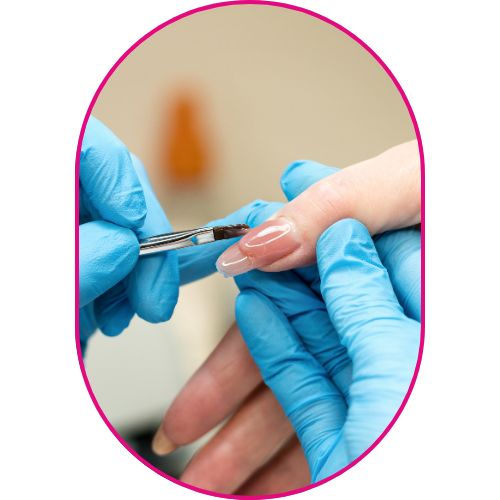
Saturate the cotton pad with acetone or Gel Off and place it directly over the gel. Wrap it tightly with foil or secure it with a remover clip. The cotton needs full contact with the nail; a loose wrap allows the acetone to evaporate before it has softened the product.
Leave the wraps in place for around 10 to 15 minutes. Thicker overlays or extensions may need longer. Manufacturer timings vary, so the response of the product is more useful than watching the clock alone. The GelBottle’s soak-off guidance allows approximately 10 to 15 minutes depending on how much product remains, while The Manicure Company advises around 15 minutes after the bulk has been filed.
Remove one wrap first and leave the others sealed. Properly softened builder should look swollen, cracked or flaky. It may lift away in soft pieces with very little pressure.
Never Scrape Builder Gel That Is Still Hard
Use a wooden manicure stick to move loosened product gently towards the free edge. Do not dig downwards into the nail plate.
If the gel resists, stop. Re-saturate the cotton and wrap the nail for another five to ten minutes. Resistance means the acetone has not penetrated the remaining product or the gel is not a soak-off formula.
The American Academy of Dermatology warns that picking or aggressively filing away gel can significantly damage the natural nail.
Builder gel should never be peeled off in one sheet, even when it appears loose. Gel remains strongly attached in some areas, and peeling can remove surface layers of keratin with it. The result may look like white patches, ridges or unusually thin nails.
What If the Gel Does Not Soften?
If the product remains smooth and hard after repeated soaking, it is likely to be hard gel or another file-off enhancement.
At this point, the safest option is a professional removal. A nail technician can reduce the hard gel without filing through the natural nail and may leave a very thin protective layer rather than trying to expose every millimetre of the nail plate.
Continuing to scrape a file-off gel will not make it soak off. It only increases the risk of thinning the nail underneath.
Look After the Nails After Removal
Once the product has been removed, use a fine buffer only where a small amount of softened residue remains. The natural nail does not need to be buffed until it looks perfectly smooth and shiny.
Wash the hands, apply cuticle oil around the nail and follow with hand cream. Acetone can temporarily leave the nail and surrounding skin feeling dry, but that does not mean the nail needs to be coated immediately with another thick enhancement.
If the nails feel tender, unusually flexible or visibly over-filed, keep them short and allow them time before the next builder application.
Stop the removal and seek professional advice if you find pain, swelling, green or dark discolouration, separation from the nail bed, broken skin or itching around the nail folds. These signs need more attention than another layer of gel.
The difference between safe removal and damaged nails is rarely the brand of acetone. It is knowing which nail product, filing only what is necessary and refusing to force off gel that is not ready to move.
