

Barber, Beauty, Hair, Hairdresser, Pamper
Hair Cutting vs Thinning Scissors: Which Should Be in a Professional Kit?

Oct
Building a professional scissor kit is easier when each pair has a clear purpose. You might need to establish a sharp outline, refine a short haircut or remove weight from a dense section, and the same tool will not suit every job. This hair cutting vs thinning scissors guide looks at the differences that matter when buying: blade design, cutting effect, fit and handedness. It is written for salon professionals and trainees choosing tools for everyday work.
Do professionals need cutting scissors or thinning scissors?
Cutting scissors establish length and shape. Thinning scissors remove selected hairs within a section to reduce bulk or soften transitions. A professional kit can include both, but they are not interchangeable. If you are building a first kit, prioritise suitable cutting scissors, then add a thinner when your training and services require it.
The distinction matters when buying. Two pairs may be the same length yet produce very different results because of their blade edges, teeth and cutting action.
What are hair cutting scissors used for?
Cutting scissors have two cutting blades rather than a comb-like thinning edge. They are used to establish a perimeter, build layers and carry out other cutting techniques appropriate to their edge design.
For example, the Jaguar Pre Style Ergo Slice Scissors 5.0 inch are described as suitable for slicing. Their blade preparation is relevant to that use; do not assume every straight-bladed pair will perform a slide cut in the same way.
Choose the size and handle around your hand and the techniques you use. A longer pair is not automatically more professional, and a smaller pair is not automatically more precise in every situation.
What are thinning scissors used for?
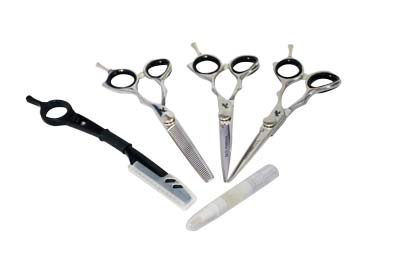
Thinning scissors have teeth on one or both blades. Those teeth allow some hairs to remain while others are cut, changing density within the section. Manufacturers may also call certain models texturising or styling scissors.
The Jaguar Pre Style Relax 28 Thinner Scissors 5.5 inch have 28 thinning teeth. Jaguar’s PRE STYLE RELAX styling scissors also illustrate how the tool’s handle design and teeth are separate buying considerations.
Tooth count alone does not tell you exactly how much hair a pair will remove. Tooth spacing, shape, the section taken and the number of closures all affect the result. Ask for the manufacturer’s cutting characteristics rather than assuming that more teeth always mean a lighter cut.
Cutting scissors vs thinning scissors comparison
| Consideration | Cutting scissors | Thinning scissors |
| Main purpose | Establish length and shape | Reduce selected bulk or soften transitions |
| Blade design | Two cutting blades | Teeth on one or both blades |
| Typical buying checks | Edge type, size, handle and handedness | Tooth design, cutting effect, handle and handedness |
| Can it replace the other tool? | Not for every thinning technique | Not for establishing a clean perimeter |
| First-kit priority | Usually the first purchase | Add for trained, intentional use |
A thinner should solve a specific density or blending problem. It should not become the default response whenever a haircut needs refinement.
How should you choose a pair for your hand?
Check whether the scissors are genuinely designed for your handedness. A right-handed blade arrangement does not become left-handed simply because the scissors can be held in the opposite hand.
The DMI Left Handed 30 Tooth Thinning Scissors 5.5 inch are an option for left-handed professionals to assess. The listing describes offset crane handles and a protective pouch. Those details can help narrow the shortlist, but the final fit still depends on the individual stylist.
Look at finger-ring fit, thumb movement and how the scissors sit during your usual cutting position. Ring inserts and a removable finger rest may help fit, where supplied, but should not be used to compensate for an unsuitable tool.
Should thinning scissors be used on every hair type?
No. Assess density, condition, existing layers and the client’s preferred finish before removing bulk. Fine or already sparse sections may have little density to spare. Curly hair needs particular attention to how each section contributes to the finished shape.
Work conservatively within your training. Comb through and reassess between passes rather than repeatedly closing the tool in the same area. The haircut should guide the decision to thin, not the availability of a new pair of scissors.
How do scissors fit into the rest of the kit?
For short services, scissors and clippers often work together. Our professional hair clipper buying guide is useful when choosing the machine that will complement your scissor work.
Compare the wider professional scissors range by task rather than finish or colour. Check product details and purchase conditions before ordering. After use, clean, dry, lubricate and store the scissors according to the maker’s instructions; adjustment and sharpening should also follow the specified method.
Frequently asked questions
Q. Can thinning scissors replace cutting scissors?
No. Their selective cutting action is not a substitute for a straight-bladed pair used to establish the haircut’s main shape and length.
Q. Are thinning and texturising scissors the same?
The terms can overlap. Compare the actual tooth design and manufacturer’s intended use rather than treating the label as a precise cutting specification.
Q. What scissors should a trainee buy first?
Buy the type, size and handedness recommended by the course provider. Add specialist tools when the relevant techniques are being taught.
